
Back to the course: Genesis: the book of beginnings
You are talking to an AI helper, not a person. Answers come from this lesson first. It cannot give quiz answers, and it can make mistakes, so please check what it says against the Bible.
📖 Memory verse: “In the beginning God created the heavens and the earth.” (Genesis 1:1)
📄 Read the words of this video
In the first part we saw that in the beginning God created everything from nothing. The earth was formless, empty and dark, and the Spirit of God was hovering over the waters.
Now we read how God gave the earth its shape and filled it, in six days. The passage is long, so we will read it in three sections, and stop after each one to see what it teaches.
And God said, “Let there be light,” and there was light. And God saw that the light was good, and He separated the light from the darkness. God called the light “day,” and the darkness He called “night.” And there was evening, and there was morning—the first day. And God said, “Let there be an expanse between the waters, to separate the waters from the waters.” So God made the expanse and separated the waters beneath it from the waters above. And it was so. God called the expanse “sky.” And there was evening, and there was morning—the second day. And God said, “Let the waters under the sky be gathered into one place, so that the dry land may appear.” And it was so. God called the dry land “earth,” and the gathering of waters He called “seas.” And God saw that it was good. Then God said, “Let the earth bring forth vegetation: seed-bearing plants and fruit trees, each bearing fruit with seed according to its kind.” And it was so. The earth produced vegetation: seed-bearing plants according to their kinds and trees bearing fruit with seed according to their kinds. And God saw that it was good. And there was evening, and there was morning—the third day. (Genesis 1:3–13, BSB)
In these first three days, God gives shape to what was formless. And He does it by separating.
On the first day, He separates the light from the darkness.
On the second, He separates the waters below from the waters above, with the sky between them. The word “expanse” simply means the open sky. Later in the chapter, it is where the birds fly.
And on the third day, He gathers the seas into their place, so that the dry land appears, and He covers it with plants.
God is bringing order. He puts each thing in its place, and gives each thing its name: “day” and “night”, “sky”, “earth” and “seas”. In the Bible, to name something is to show your authority over it. Everything belongs to God, and He decides what each thing is.
Notice something surprising. There is light on the first day, but the sun is not made until the fourth day.
That tells us that light does not depend on the sun. It depends on God. On the first three days, God Himself gave the light and divided the day from the night. On the fourth day, He set the sun, the moon and the stars in the sky to carry on that work.
And the city has no need of sun or moon to shine on it, because the glory of God illuminates the city, and the Lamb is its lamp. (Revelation 21:23, BSB)
And at the very end of the Bible, it will be like that again. In the new creation, there is no need of sun or moon, “because the glory of God illuminates the city, and the Lamb is its lamp.” The God who gave light before there was a sun will be the light of His people for ever.
Notice one more thing on the third day. The plants are “seed-bearing”, and the trees bear “fruit with seed”. And it all happens “according to their kinds”. The phrase comes again and again in the chapter.
God made a world that goes on. He did not need to create every new plant by a fresh command. He put the seed in the fruit, so that life would carry on, each kind producing its own kind, year after year. Every harvest, every apple and every grain of wheat, is God's kindness, built into the world from the first week.
And God said, “Let there be lights in the expanse of the sky to distinguish between the day and the night, and let them be signs to mark the seasons and days and years. And let them serve as lights in the expanse of the sky to shine upon the earth.” And it was so. God made two great lights: the greater light to rule the day and the lesser light to rule the night. And He made the stars as well. God set these lights in the expanse of the sky to shine upon the earth, to preside over the day and the night, and to separate the light from the darkness. And God saw that it was good. And there was evening, and there was morning—the fourth day. And God said, “Let the waters teem with living creatures, and let birds fly above the earth in the open expanse of the sky.” So God created the great sea creatures and every living thing that moves, with which the waters teemed according to their kinds, and every winged bird after its kind. And God saw that it was good. Then God blessed them and said, “Be fruitful and multiply and fill the waters of the seas, and let birds multiply on the earth.” And there was evening, and there was morning—the fifth day. (Genesis 1:14–23, BSB)
On the fourth day, God fills the sky with lights. And notice the way Moses describes them. He does not even name them “sun” and “moon”. He calls them “the greater light” and “the lesser light”. And then, almost in passing: “And He made the stars as well.”
Why speak like that? Because the nations around Israel worshipped sun, moon and stars as gods. Genesis puts them in their place. They are not gods. They are lamps that God hung in the sky, to serve His creatures: to give light, and to mark the seasons, the days and the years.
When you look to the heavens and see the sun and moon and stars—all the host of heaven—do not be enticed to bow down and worship what the LORD your God has apportioned to all the nations under heaven. (Deuteronomy 4:19, BSB)
Moses warned Israel plainly. When you look up at the sky, do not worship what you see. The sun and the stars are gifts God has given to all the nations. They are to be enjoyed, and they point us to the One who made them. But they are never to be worshipped.
People today may not bow down to the sun. But many look to the stars to tell them their future, or treat nature as if it were divine. Genesis 1 still speaks to that. The heavens declare the glory of God. They are not God.
On the fifth day, God fills the seas and the sky. The waters teem with living creatures, and birds fly across the sky.
Notice “the great sea creatures”. In the stories of the nations, the great monsters of the sea were enemies that even the gods had to fight. In Genesis there is no fight. God simply created them. They are His creatures, like everything else.
And then, for the first time in the Bible, God blesses: “Be fruitful and multiply”. God's blessing in Genesis is very often a blessing of life: of growth, of children, of fruitfulness. God loves life, and He fills His world with it.
And God said, “Let the earth bring forth living creatures according to their kinds: livestock, land crawlers, and beasts of the earth according to their kinds.” And it was so. God made the beasts of the earth according to their kinds, the livestock according to their kinds, and everything that crawls upon the earth according to its kind. And God saw that it was good. (Genesis 1:24–25, BSB)
On the sixth day, God fills the land with animals of every kind: the livestock, the creatures that crawl, and the wild animals. And then, as we will see in the next part, He makes man.
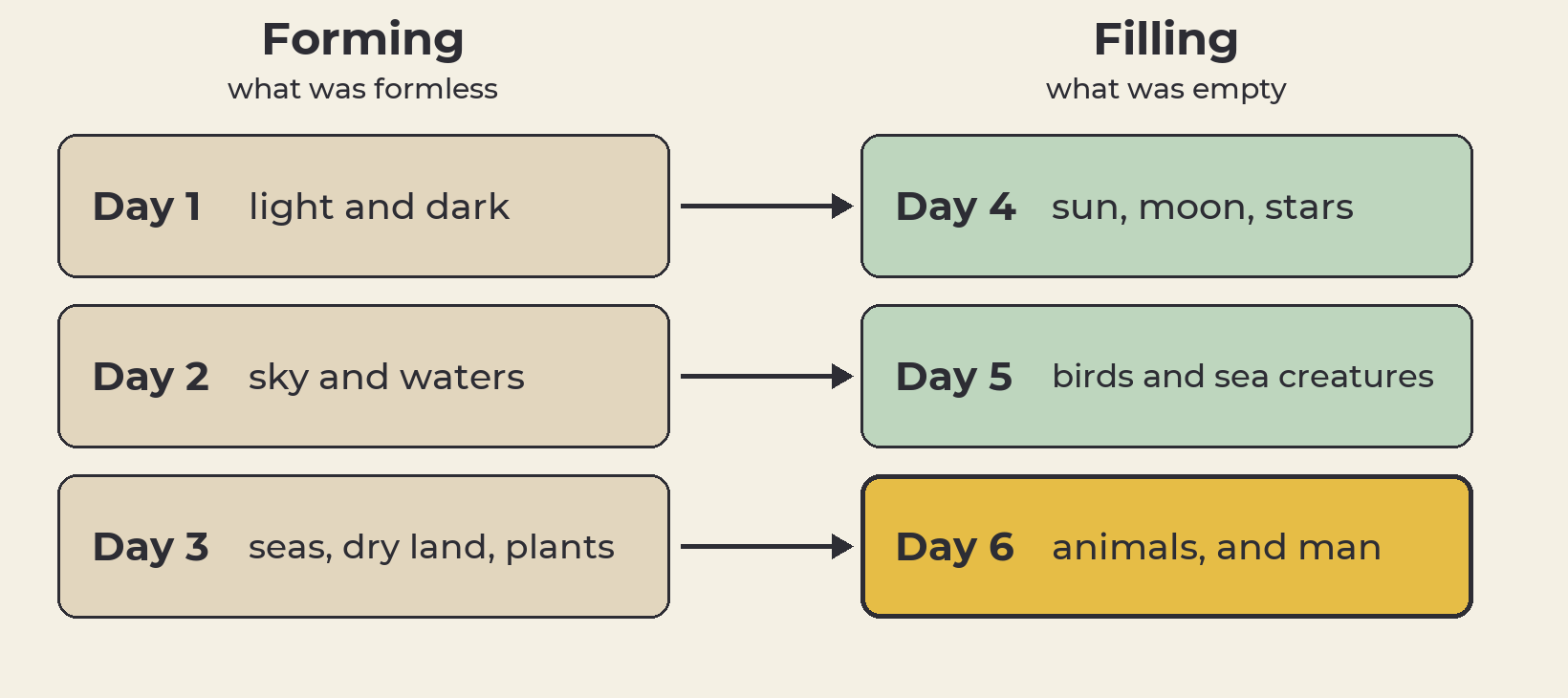
Put the six days side by side, and you can see the order in them.
In the first three days, God forms what was formless: day and night, sky and sea, and dry land with its plants. In the next three days, He fills what was empty. And each day of filling matches a day of forming. Day 1 made light, and day 4 fills the sky with lights. Day 2 made the sky and the waters, and day 5 fills them with birds and fish. Day 3 made the dry land, and day 6 fills it with animals, and then with man.
And notice how the work rises: first a world with no life, then plants, then creatures that move and breathe, and at last man. This is not a world thrown together. It is a home, carefully prepared, and then filled.
As you read the chapter, three phrases keep coming back.
The first is “And God said”. It comes ten times in the chapter. God created by speaking. He did not need tools, or helpers, or time to try things out.
The second is “And it was so”. Whatever God said happened, exactly as He said it. His word never fails.
By the word of the LORD the heavens were made, and all the stars by the breath of His mouth. He piles up the waters of the sea; He puts the depths into storehouses. Let all the earth fear the LORD; let all the people of the world revere Him. For He spoke, and it came to be; He commanded, and it stood firm. (Psalm 33:6–9, BSB)
The psalm sings what Genesis tells: “He spoke, and it came to be; He commanded, and it stood firm.” And see the response it calls for: “Let all the earth fear the LORD”. A God whose word does that deserves our reverence, and our trust.
Think what that means for the Bible in your hands. The same God who spoke the world into being speaks to us in His word. What He says, He does. His promises are as sure as His “Let there be light”.
Now listen to that same voice in the Gospels. One evening, Jesus and His disciples were crossing the Sea of Galilee when a violent windstorm came up. The waves were breaking over the boat, and Jesus was asleep in the stern. The disciples woke Him, afraid that they were going to die. And this is what happened.
Then Jesus got up and rebuked the wind and the sea. “Silence!” He commanded. “Be still!” And the wind died down, and it was perfectly calm. “Why are you so afraid?” He asked. “Do you still have no faith?” Overwhelmed with fear, they asked one another, “Who is this, that even the wind and the sea obey Him?” (Mark 4:39–41, BSB)
Jesus did not pray for the storm to stop. He spoke to it, as God spoke in Genesis 1, and the wind and the sea obeyed Him. No wonder the disciples asked, “Who is this, that even the wind and the sea obey Him?”
The answer is in Genesis. Only one voice has ever commanded the waters and been obeyed like that: the voice of the Creator. The One in the boat is the Word through whom all things were made.
The third phrase is “And God saw that it was good.”
We often think our own work is good, until someone with more skill looks at it. But this is God's verdict, and His standard is perfect. When God says it was good, it was good: ordered, beautiful, and working just as He meant it to.
That matters. Some religions teach that the material world is bad, and that the body is a prison for the soul. The Bible does not. The world God made is good. Food, and sunshine, and the body itself, are His good gifts, to be received with thanks.
The world as we know it now is not quite that world. In chapter three, we will see what spoiled it. But even now, its order and beauty still speak of the Creator.
How many are Your works, O LORD! In wisdom You have made them all; the earth is full of Your creatures. (Psalm 104:24, BSB)
This is how the psalmist responds when he looks at the world: with wonder and praise. “In wisdom You have made them all”. Every creature is a sign of God's wisdom. The more we learn about the world, the more reason we have to praise Him.
Many people ask: were these six ordinary days, or long ages? Genesis 1 is not poetry. It is written as an account of what happened, and the Bible gives us good reasons to read these as ordinary days.
First, each day is marked with “there was evening, and there was morning”. Those words mark an ordinary day.
Second, the days are numbered: the first day, the second day, the third. When the Old Testament numbers days like this, it means ordinary days.
Third, in the same chapter, the word “day” is used in its ordinary sense. The lights are to mark “seasons and days and years”.
And fourth, God Himself, when He gave the Ten Commandments, based our week on the six days of creation.
For in six days the LORD made the heavens and the earth and the sea and all that is in them, but on the seventh day He rested. Therefore the LORD blessed the Sabbath day and set it apart as holy. (Exodus 20:11, BSB)
“In six days the LORD made the heavens and the earth”. God tells His people to work for six days and rest on the seventh, because that is what He did. Our week of seven days does not come from the sun or the moon or the seasons. It comes from the creation week.
Here God Himself explains Genesis 1 to us: six days of work, and a day of rest. That is the plain sense of the passage, and that is how we will read it. Genesis is not a science textbook, and it does not answer every question we might like to ask. But what it tells us is true, because God, who was there, has told us.
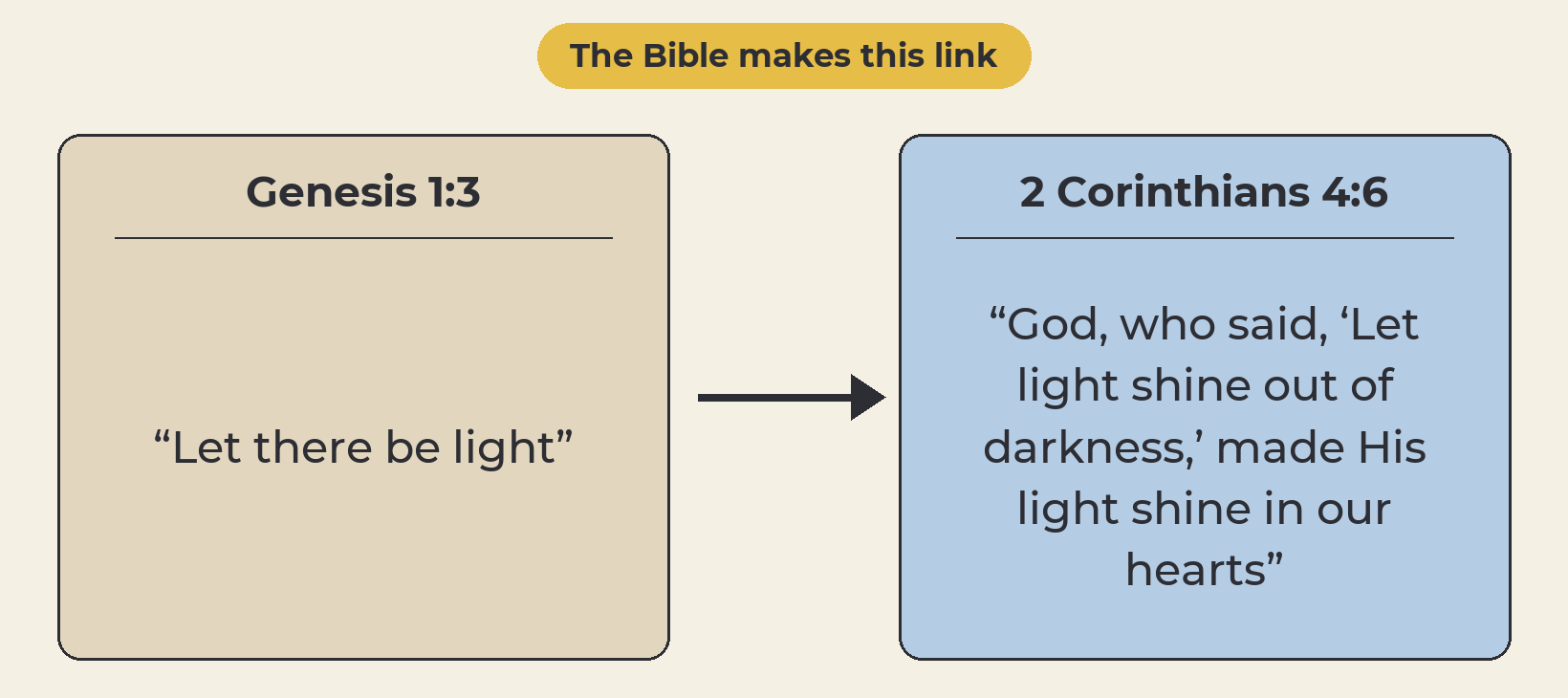
Now we come back to the first day. And here the Bible itself makes a link for us. Many centuries later, the apostle Paul looked back at the first words God spoke in creation, and saw in them a picture of what God does when He saves someone.
For God, who said, “Let light shine out of darkness,” made His light shine in our hearts to give us the light of the knowledge of the glory of God in the face of Jesus Christ. (2 Corinthians 4:6, BSB)
“God, who said, 'Let light shine out of darkness'”. That is Genesis 1:3. And the same God, Paul says, “made His light shine in our hearts”, so that we see “the glory of God in the face of Jesus Christ”.
Think about the first day. The earth was dark and formless. It could not make light for itself. It did not even ask for light. God spoke, and there was light.
A human heart without God is like that. It is dark. It cannot see the glory of Christ, and it cannot make itself see. But God speaks through His word, His Spirit works, and the light shines. When someone becomes a Christian, it is like the first day of creation all over again. Only God can do it.
A bruised reed He will not break and a smoldering wick He will not extinguish; He will faithfully bring forth justice. (Isaiah 42:3, BSB)
And there is something here to encourage you, if you are new to the faith. On the first day, there was only light. No plants, no animals, no people yet. But “God saw that the light was good.”
When God begins His work in a heart, it may look very small at first: a little light, a little faith. But God sees it, and He calls it good. He does not despise small beginnings. This verse in Isaiah speaks of the Lord's Servant, the Lord Jesus: “A bruised reed He will not break and a smoldering wick He will not extinguish”. The God who finished the work of creation will finish the work He has begun in you.
To finish, some questions to think about.
What does the order and care of the six days tell you about God?
Where do you see His wisdom and His goodness in the world around you today?
And has the God who said “Let there be light” made His light shine in your heart? If you are not sure, ask Him. He still speaks, and He still gives light.
In the last part of this study, we come to the sixth day: man and woman, made in the image of God. And then the seventh day.
Genesis 1:3–25
Now we read how God gave the earth its shape and filled it, in six days. The passage is long, so read it in three sections, and stop after each one.
1. Days 1 to 3: God forms what was formless (1:3–13). God does it by separating. On the first day He separates the light from the darkness. On the second, the waters below from the waters above, with the sky between them ("expanse" simply means the open sky). On the third, He gathers the seas into their place so that the dry land appears, and He covers it with plants. And He names each thing: "day" and "night", "sky", "earth" and "seas". In the Bible, to name something is to show your authority over it.
📖 Read Genesis 1:3–13
What does God separate on each of the first three days? What does He name?
3And God said, “Let there be light,” and there was light. 4And God saw that the light was good, and He separated the light from the darkness. 5God called the light “day,” and the darkness He called “night.” And there was evening, and there was morning—the first day. 6And God said, “Let there be an expanse between the waters, to separate the waters from the waters.” 7So God made the expanse and separated the waters beneath it from the waters above. And it was so. 8God called the expanse “sky.” And there was evening, and there was morning—the second day. 9And God said, “Let the waters under the sky be gathered into one place, so that the dry land may appear.” And it was so. 10God called the dry land “earth,” and the gathering of waters He called “seas.” And God saw that it was good. 11Then God said, “Let the earth bring forth vegetation: seed-bearing plants and fruit trees, each bearing fruit with seed according to its kind.” And it was so. 12The earth produced vegetation: seed-bearing plants according to their kinds and trees bearing fruit with seed according to their kinds. And God saw that it was good. 13And there was evening, and there was morning—the third day.
Genesis 1:3–13 (BSB)
2. Light before the sun. There is light on the first day, but the sun is not made until the fourth. Light does not depend on the sun; it depends on God. And at the very end of the Bible it will be like that again.
See also: Revelation 21:23.
3. "According to their kinds." The plants are "seed-bearing", and the trees bear "fruit with seed", each "according to its kind". God made a world that goes on: He put the seed in the fruit, so that life would carry on, year after year. Every harvest is God's faithfulness still at work.
4. Days 4 to 6: God fills what was empty (1:14–25). On the fourth day He fills the sky with lights. Moses does not even name them "sun" and "moon": he calls them "the greater light" and "the lesser light", and the stars come almost in passing. The nations around Israel worshipped sun, moon and stars as gods. Genesis puts them in their place: they are lamps God hung in the sky to serve His creatures.
📖 Read Genesis 1:14–23
What are the lights in the sky for? What does God say to the creatures of the sea and the air?
14And God said, “Let there be lights in the expanse of the sky to distinguish between the day and the night, and let them be signs to mark the seasons and days and years. 15And let them serve as lights in the expanse of the sky to shine upon the earth.” And it was so. 16God made two great lights: the greater light to rule the day and the lesser light to rule the night. And He made the stars as well. 17God set these lights in the expanse of the sky to shine upon the earth, 18to preside over the day and the night, and to separate the light from the darkness. And God saw that it was good. 19And there was evening, and there was morning—the fourth day. 20And God said, “Let the waters teem with living creatures, and let birds fly above the earth in the open expanse of the sky.” 21So God created the great sea creatures and every living thing that moves, with which the waters teemed according to their kinds, and every winged bird after its kind. And God saw that it was good. 22Then God blessed them and said, “Be fruitful and multiply and fill the waters of the seas, and let birds multiply on the earth.” 23And there was evening, and there was morning—the fifth day.
Genesis 1:14–23 (BSB)
📖 Read Deuteronomy 4:19
What does Moses warn Israel not to do when they look at the sky?
When you look to the heavens and see the sun and moon and stars—all the host of heaven—do not be enticed to bow down and worship what the LORD your God has apportioned to all the nations under heaven.
Deuteronomy 4:19 (BSB)
On the fifth day God fills the seas and the sky. In the stories of the nations, the great monsters of the sea were enemies that even the gods had to fight. In Genesis there is no fight: God simply created "the great sea creatures". And for the first time in the Bible God blesses: "Be fruitful and multiply." On the sixth day He fills the land with animals of every kind, and then He makes man.
See also: Genesis 1:24–25.
5. Three phrases repeated. "And God said": ten times in the chapter. God created by speaking, with no tools, helpers or trials. "And it was so": whatever God said happened, exactly as He said it. "And God saw that it was good": the verdict of the One whose standard is perfect.
📖 Read Psalm 33:6–9
How were the heavens made? What should all the earth do?
6By the word of the LORD the heavens were made, and all the stars by the breath of His mouth. 7He piles up the waters of the sea; He puts the depths into storehouses. 8Let all the earth fear the LORD; let all the people of the world revere Him. 9For He spoke, and it came to be; He commanded, and it stood firm.
Psalm 33:6–9 (BSB)
The same voice is heard in the Gospels. One evening, crossing the Sea of Galilee, Jesus spoke to the wind and the sea, and they obeyed Him. Only one voice has ever commanded the waters like that: the voice of the Creator.
📖 Read Mark 4:39–41
What did Jesus say to the wind and the sea? What did the disciples ask one another?
39Then Jesus got up and rebuked the wind and the sea. “Silence!” He commanded. “Be still!” And the wind died down, and it was perfectly calm. 40“Why are you so afraid?” He asked. “Do you still have no faith?” 41Overwhelmed with fear, they asked one another, “Who is this, that even the wind and the sea obey Him?”
Mark 4:39–41 (BSB)
6. "It was good." Some religions teach that the material world is bad, and that the body is a prison for the soul. The Bible does not. Food, sunshine and the body itself are God's good gifts, to be received with thanks. The world as we know it now is not quite that world (chapter 3 will show what spoiled it), but its order and beauty still speak of the Creator.
See also: Psalm 104:24.
7. Six ordinary days. Genesis 1 is not poetry. It is written as an account of what happened, and the Bible gives good reasons to read these as ordinary days. Each day is marked "there was evening, and there was morning". The days are numbered. In the same chapter, "day" is used in its ordinary sense ("seasons and days and years"). And God Himself, in the Ten Commandments, based our week on the six days of creation. Genesis is not a science textbook, and it does not answer every question we might ask. But what it tells us is true, because God, who was there, has told us.
📖 Read Exodus 20:11
In how many days did the LORD make the heavens and the earth? What did He do on the seventh day?
For in six days the LORD made the heavens and the earth and the sea and all that is in them, but on the seventh day He rested. Therefore the LORD blessed the Sabbath day and set it apart as holy.
Exodus 20:11 (BSB)
8. Light in our hearts. Here the Bible itself makes a link. Paul looks back at God's first words in creation and sees in them what God does when He saves someone. The dark, formless earth could not make light for itself, and did not even ask for it. A human heart without God is like that, until God speaks and the light shines.
📖 Read 2 Corinthians 4:6
What has God done in our hearts? In whose face do we see the glory of God?
For God, who said, “Let light shine out of darkness,” made His light shine in our hearts to give us the light of the knowledge of the glory of God in the face of Jesus Christ.
2 Corinthians 4:6 (BSB)
Small beginnings
On the first day there was only light: no plants, no animals, no people yet. But "God saw that the light was good." When God begins His work in a heart, it may look very small at first. But God sees it, and He calls it good. He does not despise small beginnings.
📖 Read Isaiah 42:3
What will the Lord's Servant, the Lord Jesus, not do to a bruised reed or a smouldering wick?
A bruised reed He will not break and a smoldering wick He will not extinguish; He will faithfully bring forth justice.
Isaiah 42:3 (BSB)
Reflect
Take a few minutes to think about these questions. You can write your answers down, or share your thoughts in the comments below.
- What does the order and care of the six days tell you about God?
- Where do you see His wisdom and His goodness in the world around you today?
- Has the God who said "Let there be light" made His light shine in your heart? If you are not sure, ask Him. He still speaks, and He still gives light.
Scripture quotations are from the Berean Standard Bible (BSB), which is in the public domain. They keep its American spelling. Like many English Bibles, it often says ‘man’, ‘he’ or ‘brothers’ where it means people in general, men and women alike.